
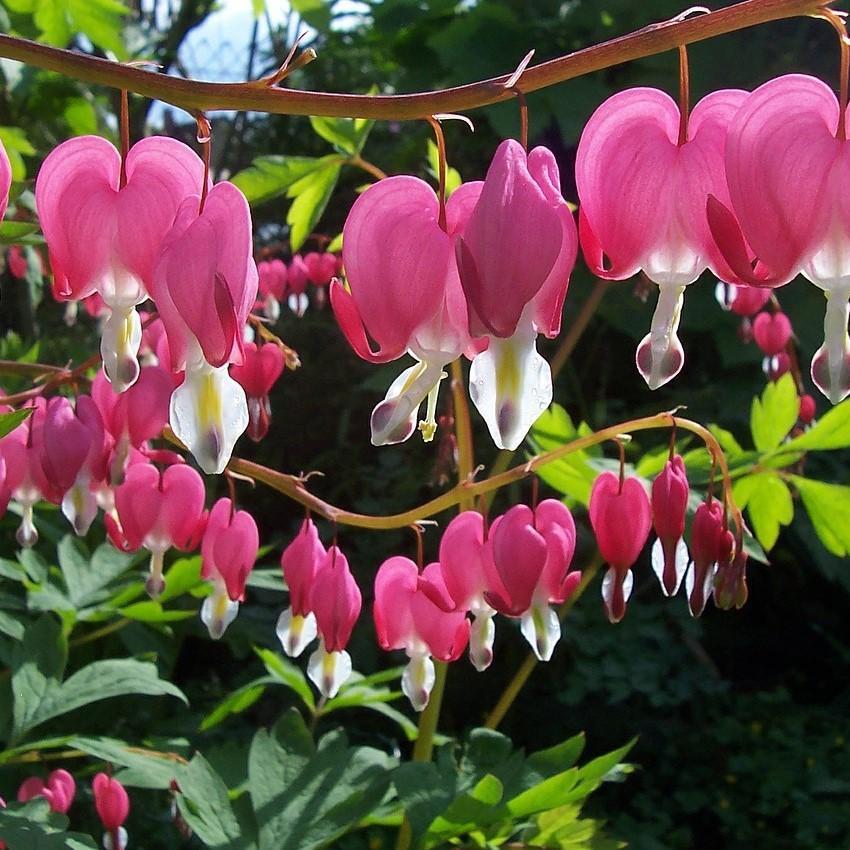
The History of Bleeding Hearts
Dicentra spectabilis (now often classified as Lamprocapnos spectabilis) is one of those spring flowers that feels like a love letter—arching stems, heart-shaped blooms, and an old-fashioned charm that never goes out of style.
 hearts in bloom (16:9)
A Flower That Makes People Feel Something
Bleeding hearts aren’t just pretty—they’re expressive. Those dangling, heart-shaped blossoms look like they were designed for storytelling. And in a way, they were: this plant’s journey from Asian woodlands to Victorian gardens is full of romance, discovery, and a little botanical drama.
If you’ve ever planted bleeding hearts and wondered why they disappear in summer—don’t worry. That “vanishing act” is part of their woodland rhythm, and we’ll talk about it below.
Woodland Origins: Where Bleeding Hearts Began
The old-fashioned bleeding heart is native to cool woodland regions of northeastern Asia—think moist forest soils, dappled light, and springtime that arrives gently rather than with a bang. In these habitats, plants bloom early before tree canopies fully leaf out.
- Native range: parts of China, Korea, and Japan
- Natural habitat: woodland edges, forest understory, rich humus soils
- Seasonal behavior: spring bloom + summer dormancy (especially in heat)
The 1800s: Plant Hunters & the Victorian Garden Boom
In the mid-19th century, European gardeners were obsessed with new ornamental plants—especially anything that felt exotic, romantic, or “storybook.” This was the era of plant explorers collecting specimens across Asia, bringing them back to Europe where they rapidly became garden celebrities.
Why Victorians loved it
- Heart-shaped blooms = instant symbolism
- Graceful arching stems = perfect for cottage gardens
- Blooms in spring when the garden feels brand new
A quick note on names
Many gardeners still call it Dicentra spectabilis, but you’ll also see Lamprocapnos spectabilis on updated tags and botanical references. Same plant, same charm—new classification.
Bleeding Heart Timeline
-
Pre-1800sThrives quietly in Asian woodlands—adapted to spring light, cool soil, and forest understories.
-
Mid-1800sIntroduced into European horticulture during the golden age of plant exploration and collecting.
-
Late 1800sBecomes a cottage garden staple in Europe and North America—beloved for romance, form, and early-season impact.
-
Modern eraReclassified by many botanists as Lamprocapnos spectabilis, while gardeners continue using the classic name.
Meaning & Symbolism: The “Language of Flowers”
During the Victorian era, floriography (the language of flowers) was a real social code—bouquets weren’t just pretty, they were messages. Bleeding hearts naturally became a symbol of love, tenderness, and devotion… sometimes even heartbreak.
- 💗 Romantic devotion
- 🤍 Compassion & empathy
- 🕊️ “I remember you” / enduring affection
- 💔 (sometimes) heartbreak—because, well… look at it
Why It “Disappears” in Summer (and Why That’s Normal)
One of the most common surprises with bleeding hearts is that the foliage can yellow and die back after bloom—especially in warmer climates. That’s not a failure. It’s a survival strategy.
Woodland rhythm
In nature, bleeding hearts bloom early while sunlight reaches the forest floor. When summer heat arrives and trees fully leaf out, the plant retreats underground and rests.
Graceful design tip
Plant bleeding hearts with companions that “take over” as they fade—hostas, ferns, heuchera, brunnera, astilbe, and hellebores are perfect.
Classic Pink vs. Elegant White
The traditional rosy-pink bleeding heart is iconic, but the white form (often sold as ‘Alba’) is equally dreamy—especially in shade gardens where you want a little glow.
- Pink: storybook, nostalgic, cottage garden romance
- White (‘Alba’): moon-garden magic, pairs beautifully with deep greens and dusky blooms
Bleeding hearts + hellebores in early spring is a match made in heaven. Add ferns and you’ve basically created a woodland painting.
The Takeaway
From cool Asian woodlands to Victorian-era fascination to modern shade borders, bleeding hearts have stayed beloved for one reason: they’re not just a plant—you feel them.
They bloom like a love letter in spring, then quietly rest. And every year, they come back with the same soft drama—no extra effort required.



%20is%20one%20of%20those%20spring%20flowers%20that%20feels%20like%20a%20love%20lette...)