





Grace Rose Farm • Bare Root Rose Care
Sweating Bare Root Roses
How to wake up sleepy roses, understand dormancy biology, and know exactly when (and how) to sweat for a strong start.
Quick reassurance: Most non-leafed out bare root roses are not dead — they’re simply dormant. Sweating is a grower-approved way to gently nudge buds into motion.

Every spring at Grace Rose Farm we hear the same worried question: “My bare root rose looks alive… but it isn’t doing anything. Did I get a dud?”
Almost always, the answer is no. What you’re seeing is a rose that is still in deep dormancy — and that’s where sweating becomes one of the most helpful tools a rose grower can use.
What does “sweating” mean?
Sweating creates a warm, humid microclimate around the canes that tells the rose: “It’s spring. It’s safe. Start growing.”
This isn’t a gimmick — it’s a professional technique used by rose nurseries to encourage slow-to-wake varieties to break dormancy.
Why Some Bare Root Roses “Sleep In”
Bare root roses are lifted from the field while dormant and stored in refrigerated, high-humidity coolers for weeks (sometimes months). That keeps them healthy — but paused in time.
Often faster to wake
- Old Garden Roses
- Rugosas
- Hybrid Musks
- Many Shrub Roses
Often slower to wake
- Hybrid Teas
- Grandifloras
- Florist-style roses
- Many dark-colored varieties
- High-petal-count roses
Grace Note: Roses that have been in cold storage longer can take more time to come out of dormancy — even when planted correctly. Patience + the right humidity makes all the difference.
The Biology Behind Dormancy (and What Triggers Awakening)
Dormancy is a rose’s built-in survival mode. Inside each cane and bud are plant hormones that act like tiny on/off switches:
The “sleep” signal
Abscisic acid (ABA) helps keep buds closed and growth paused through winter conditions.
The “wake & grow” signals
Gibberellins & cytokinins support cell division, bud expansion, and new shoot growth.
Roses don’t wake up because of time — they wake up because of signals. The biggest triggers are:
1) Warmth
Rising temperatures help shift the rose out of winter mode.
2) Moisture
Rehydration supports hormone changes and restarts growth processes.
3) Humidity around buds
High humidity prevents moisture loss and helps buds build pressure to swell and open.
Why sweating works so well
Sweating bundles the three “wake-up triggers” into one simple setup: warm + moist + humid — a mini springtime greenhouse right around the canes.
Dormant vs. Dead: The Fast Check
Quiet growth doesn’t mean failure. Before you worry, use this quick guide.
🌱 Dormant (alive + sleeping)
- Canes feel firm
- Bark is smooth (not deeply wrinkled)
- Buds look tight/flat with little movement
- Roots bend without crumbling
- Scratch test shows green or creamy tissue
What to do: Plant normally. If no bud swell after 10–14 days, consider sweating.
💀 Dead (no viable tissue)
- Canes are brittle and snap easily
- Scratch test shows brown all the way through
- Roots crumble when bent
- Wood appears hollow or severely shriveled
What to do: This rose is unlikely to recover.
The Scratch Test (Do This First)
Gently scrape the bark on a cane with a clean fingernail or knife.
| Color Under Bark | Meaning |
|---|---|
| Green | Alive and healthy |
| Cream / light tan | Alive but dormant |
| Brown | Dead tissue |
Tip: If even one cane shows green, the rose is alive and worth sweating.
When to Try Sweating
- 10–14 days after planting with no bud swell
- Canes look firm but inactive
- Rose was in cold storage for a long time
- Scratch test shows living tissue, but nothing is moving
- If a bare root rose is received and is severely dehydrated
Do not wait until canes are dehydrated. Sweating works best when the rose is still healthy and hydrated.

How to Sweat a Bare Root Rose (Step-by-Step)
-
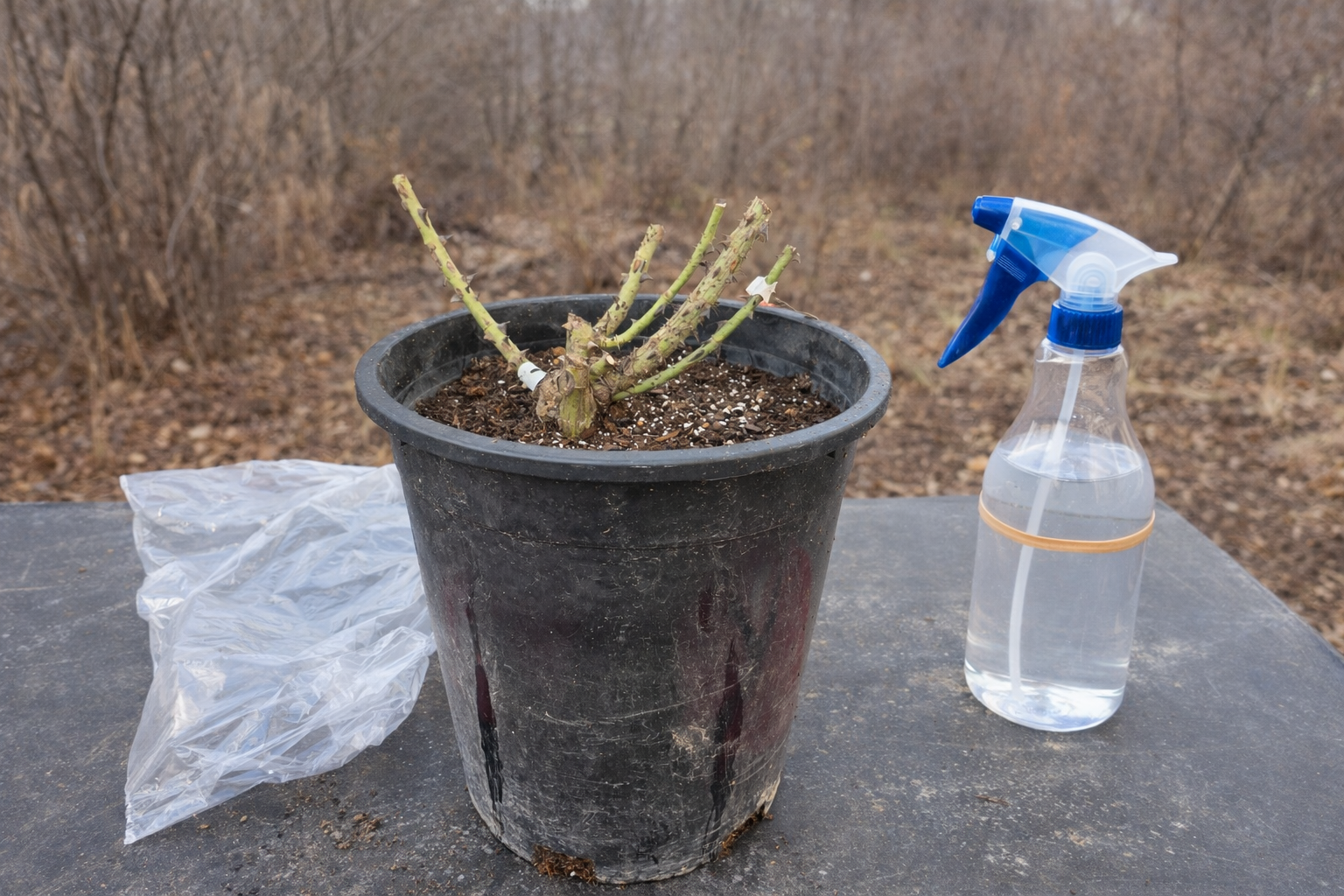
Cut canes back to 6 inches
Trim canes to about 6 inches to reduce stress and redirect energy into bud break.
-
Mist the canes thoroughly
Mist until the canes and buds are evenly wet — moist, not dripping.

-
Cover canes with a clear plastic bag
Use a clear bag and fully cover the canes. Secure loosely at the base so humidity stays trapped. (Think: gentle greenhouse.)
-
Do not place the rose in direct sunlight - dappled shade or shade is OK - as long as it's warm enough to create humidity, but not create a super heated greenhouse that can burn new and emerging buds.
-
Keep humidity high (never let canes dry out)
Mist inside the bag at least once per day — and in dry air, several times per day. The canes should never dry out.
-
Remove plastic the moment buds swell
As soon as buds swell or show green, remove the bag immediately. Leaving it on too long can cause weak growth and encourage fungal issues.

The #1 rule
Humidity wakes the rose. Dry canes = sleeping. Moist canes + humidity = waking.
The Sweating Timeline: What to Expect
Day 1
The Reset
- Canes rehydrate and may look slightly darker
- Buds can still appear tight/flat
- The internal “wake-up” shift begins
Day 3–5
Bud Swell
- Buds become plump and raised
- Tiny green tips may appear
- This is the turning point
Day 7–10
First Green
- Leaf tips emerge (often red/bronze/green)
- Growth becomes clearly visible
- Remove plastic now
Day 10–14
Normal Growth Resumes
- Leaves expand, shoots lengthen
- The rose is fully in spring mode
If nothing happens by Day 10: If the scratch test still shows green, re-mist, re-bag, and keep going. Some varieties are simply cautious and take longer to break dormancy.
Common Questions
Only one cane is waking up — is that okay?
Yes. Roses often wake unevenly. If one cane is pushing growth, the rest commonly follow. If a cane is truly dead (brown through on scratch test), prune it away so the plant focuses energy on living tissue.
How long should I sweat?
Many roses show movement in 3–14 days. Remove the bag as soon as buds swell or show green.
Final Thoughts
A dormant rose is not a bad rose. It’s simply a rose waiting for the right signal. Sweating provides that signal gently — so your rose can root, grow, and bloom with strength all season long.
Happy Gardening!
Heidi





%20to%20sweat%20for%20a%20strong%20start.%0A%0AQuick%20reass...)